




For your business, a tote bag is more than a carrier; it’s a mobile billboard. However, the most expensive logo is worthless if the handle snaps. The real strength of a heavy-duty construction bag isn’t just in the fabric—it’s in the geometry of the stitching. Let’s look at how handle engineering determines a bag’s lifespan.
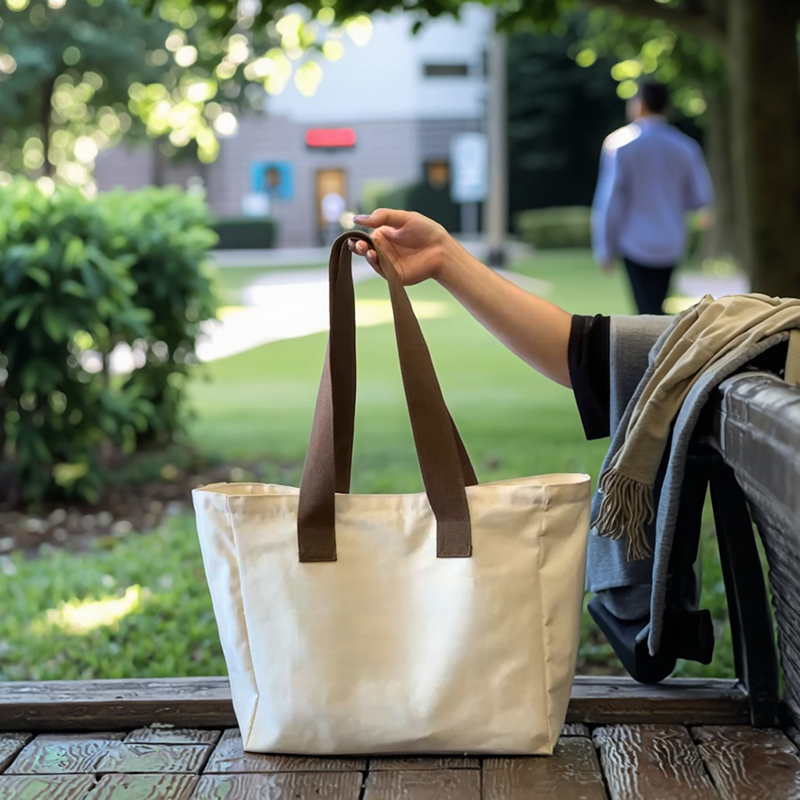
When you pick up a high-capacity bag, you probably don’t think about the thread. But for anyone in the world of professional logistics, that tiny line of string is the only thing standing between a happy customer and a pile of broken groceries on the sidewalk. Generally, the industry relies on a few specific ways to anchor a handle to a bag.
The Vertical Seam (The Entry Level): This is the simplest way to do it. The handle is tucked under the top hem and sewn with one or two straight lines. It’s fine for carrying a couple of light t-shirts or a loaf of bread, but if you tug on it with a heavy load, you can actually see the fabric start to stretch and deform. It’s a “lightweight” solution for simple needs.
The “Box Stitch” (The Reliable Middle): Instead of just one line, the needle travels in a square. This creates a much larger “anchor” on the fabric. By spreading the weight over a square inch instead of a single point, the load bearing capacity jumps significantly. It’s the standard for most retail shopping bags.
The “X-Stitch” (The Gold Standard): If you look at a professional heavy-duty construction tote, you’ll see a box with a big “X” sewn right through the middle. This isn’t for decoration. The diagonal lines lock the vertical and horizontal fibers of the fabric together. It’s like adding a structural brace to a building; it stops the handle from twisting and ensures the bag can handle 10kg or more without breaking a sweat.
Ultrasonic Welding (The Threadless Bond): In many 无纺布袋 products, there is no thread at all. Instead, high-frequency vibrations melt the plastic fibers together. It’s fast and clean. While it doesn’t have the “give” of a traditional stitch, it’s a brilliant, cost-effective way to create a solid bond for medium-weight promotional items.
| Stitching Method | Mechanical Action | Performance & Best Use |
| Vertical Seam | Tucked under the top hem with straight lines. | Entry Level: Fine for light items; fabric may deform under heavy loads. |
| Box Stitch | Needle travels in a square to create a larger anchor. | Reliable Middle: Significantly increases load-bearing capacity; retail standard. |
| “X-Stitch” | A box with a diagonal “X” sewn through the middle. | Gold Standard: Structural brace that stops twisting; handles 10kg or more. |
| Ultrasonic Welding | High-frequency vibrations melt plastic fibers together. | Threadless Bond: Fast and cost-effective for medium-weight promotional items. |
How a bag handles gravity is a game of physics. If the stitching is wrong, even the strongest fabric will fail.
Tension Distribution
Think of the handle like a bridge cable. If all the weight pulls on one single needle hole, the fabric will eventually “run” like a pair of stockings. A professional “X-Stitch” acts like a net. It grabs a larger surface area of the bag’s body, so when you lift it, the tension is shared by hundreds of fabric fibers rather than just ten.
Thread Choice and Tensile Strength
You can have the best stitch pattern in the world, but if you use weak cotton thread, the bag is doomed. High-performance bags use synthetic threads, like bonded nylon or high-density polyester. These threads have a massive tensile strength of their own. They can stretch slightly under a heavy load—like a shock absorber—and then snap back to their original shape without snapping.
The Power of the “Backstitch”
Have you ever seen a thread start to unravel at the edge of a bag? That’s because the person or machine didn’t “backstitch.” A quality build involves sewing forward, then hitting the reverse for a few stitches, then going forward again. This “locks” the thread in place. It ensures that even if one loop gets snagged on a sharp corner, the whole handle won’t come zipping off.
Stitches Per Inch (SPI): The “Postage Stamp” Problem
There is a secret “Goldilocks zone” for stitching. If you have too few stitches, the handle is loose and weak. But if you have too many stitches—say, 20 stitches in a tiny space—the needle actually cuts the fabric. It turns the fabric into a perforated line, much like the edge of a postage stamp. When you pull it, the fabric just rips right along that line. A professional heavy-duty construction finds that perfect balance where the thread holds tight without “chopping” the fabric.
Reinforcement Layers (The Hidden Header)
If you open up a high-quality tote and look at the inside where the handle meets the bag, you’ll often find an extra strip of fabric. This is called a “header.” It doubles the thickness at the stress point. This simple addition can increase the load bearing capacity of a standard polyester drawstring bag or tote by 50%. It gives the needle more “meat” to bite into, preventing the handle from ripping out of the main body.
When your business is ordering thousands of units, you need to match the “carry” to the “cargo.”
Assess the Cargo: Don’t over-engineer a bag for a bag of popcorn, but don’t under-engineer one for a 12-pack of soda. If you expect your customers to use the bag for heavy groceries, the “X-Stitch” is mandatory. It’s the difference between a bag they keep for years and one they throw away after it fails them in the parking lot.
The “Hand-Feel” vs. Strength: A wider handle is more comfortable on the shoulder because it doesn’t “dig in.” However, a wider handle also needs a wider stitching base. Ensuring the handle width matches the stitch box is key to a balanced heavy-duty construction.
Budgeting for Durability: Yes, an “X-Stitch” or a reinforced header costs a few cents more per unit. But look at the ROI. A bag that lasts 2 years provides 2 years of free advertising. A bag that breaks in a week is just a waste of money and a hit to your brand’s reputation for quality.
Sustainable Packaging Solution: The most eco-friendly thing a bag can do is stay out of the landfill. By choosing superior stitching, you are providing a sustainable packaging solution that supports carbon footprint reduction. One strong bag replaces 500 plastic ones. If it doesn’t break, it keeps working for the planet.
Is “X-Stitch” really stronger than a regular box stitch?
Yes. The “X” prevents the fabric from concentrated tearing, significantly increasing the bag’s total load bearing capacity.
Can an ultrasonic heat-sealed handle carry heavy groceries?
It is ideal for lightweight retail, but for heavy groceries, a stitched “X” pattern offers much higher tensile strength.
What is the best handle length for a heavy-duty tote bag?
Usually 50-60cm. This allows for shoulder carry while ensuring the angle of tension doesn’t stress the stitching points.
How can I test the stitching quality of a sample bag?
Give the handle a sharp “snap” pull. If you see the fabric gaps or threads stretching, quality is low.
The handle is the most stressed part of any tote bag. By choosing the right stitching geometry and thread quality, your business ensures a product that survives years of heavy use. At Zhongjin, we treat every stitch as a structural choice to protect your brand’s reputation. 联系我们 for a sample and test our strength yourself.