

Summary: Die-cutting, fabric weight and hard bottom boards decide how a custom soccer shape drawstring bag looks and ships. Here is how to specify all three.
A soccer ball–shaped drawstring bag gets noticed in a way a rectangular one never will. But the shape is only the visible part of the decision. Behind it sit three spec choices that decide whether the bag looks sharp on match day and whether it still works in a warehouse: how the panel is die-cut, which fabric has to carry that shape, and how the bottom is supported inside. This guide walks you through all three from a manufacturer’s side of the table, so you can brief a supplier with numbers instead of adjectives.
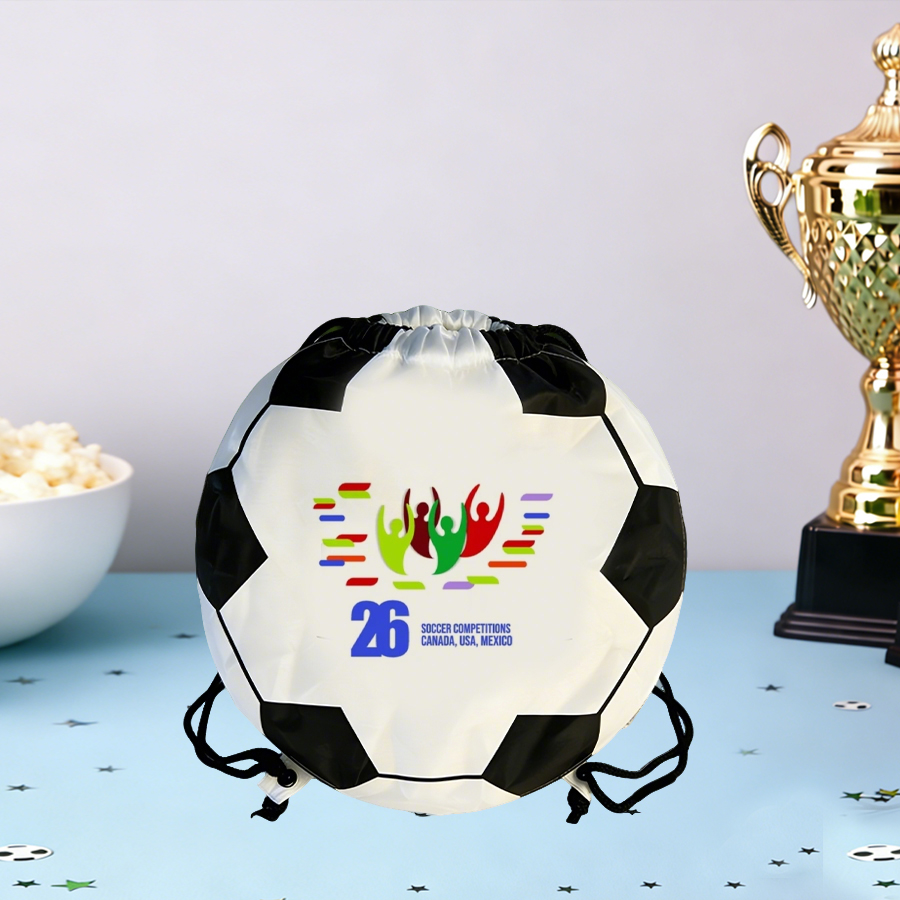
A shaped panel in 210D polyester: the drawstring channel runs behind the printed ball face, so the artwork stays clean.
A standard drawstring bag is a rectangle sewn on three sides with a channel at the top. Its load sits on a straight seam, and that seam is what keeps the bag from sagging. Cut the panel into a curve, and you remove exactly that straight edge. The bag now has no natural floor.
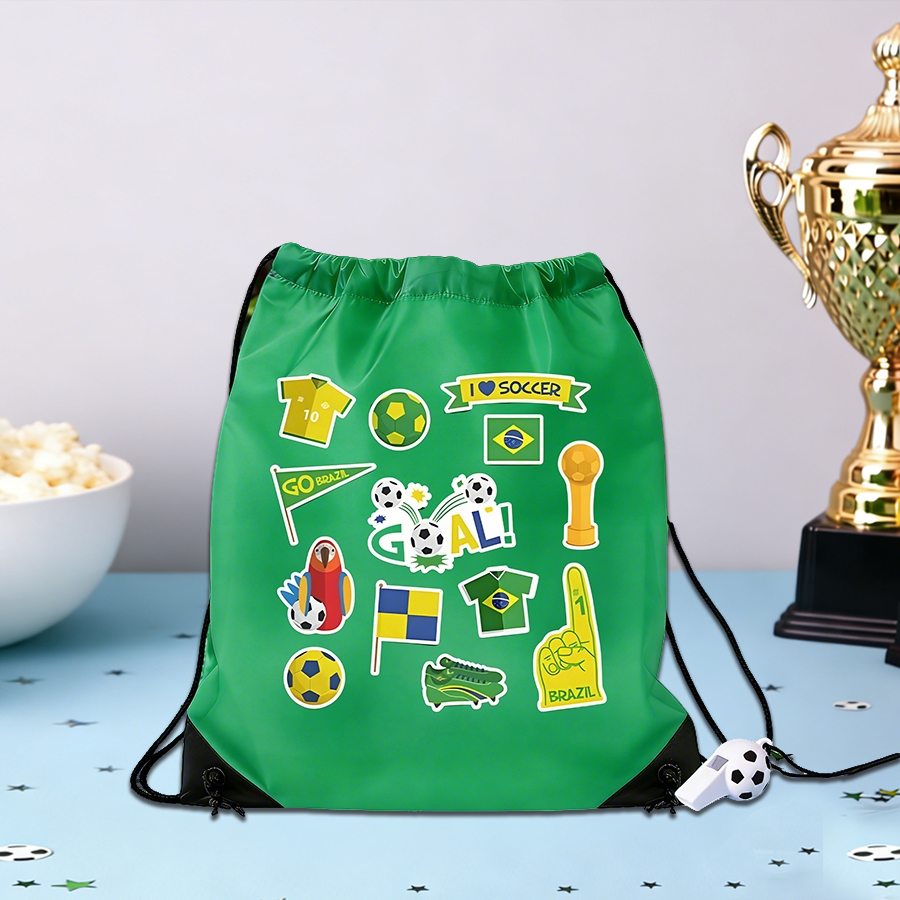
The rectangle you are replacing: a printed 210D drawstring bag keeps a straight base seam, which is what a shaped panel gives up.
That is the point most first-time buyers miss when they order custom soccer shape drawstring bags. The shape is a printing and cutting problem, but the flat bottom it leaves behind is a structural problem. Solve the second one and the bag survives a full season. Ignore it and you get a bag that collapses the moment someone drops a water bottle into it — and that is also why custom shaped drawstring bags quote higher than a rectangle at the same volume.
Die-cutting is not a printing effect. It is a separate tooling step, and on soccer fan gift drawstring bags it drives the timeline more than the print does. This is the sequence we run at Zhongjin when a shaped program starts, and the order of the three steps is what separates a smooth customization from an expensive re-run.
The die line is the vector outline of the finished shape, plus the drawstring channel, seam allowance and fold marks. Approve this file first. If you approve artwork on a rectangular mockup and only then ask for a shape, every print position you signed off has to be re-laid out, and the die has to be cut twice. A shaped bag has curved edges, so there is no straight reference for the printer to align to. The die line is that reference.
Woven and knitted polyester both fray along a cut edge. On a rectangle the fraying hides inside a seam. On a curve it is exposed, right where the buyer’s hand goes. Production therefore seals the outline as it cuts: ultrasonic sealing or a hot-knife trim melts the yarn ends and leaves a clean, slightly rounded edge. Ask your supplier which method they use. A cold steel-rule cut with no sealing will look fine in a photo and shed fibres after a month of use.
Shaped panels lose printable space at the curves. Budget roughly 5–8 mm of bleed and a similar safety margin inside the cut line, then check that your logo still reads when the panel is curved and partly filled. A sponsor logo placed near a curve will distort and partially disappear once the bag is stuffed. If your artwork is edge-to-edge, ask for a shaped panel with a printed flat and a plain border instead — it costs less tooling and survives the curve better.
A hard bottom board is a rigid insert — usually PE or PP sheet, sometimes a stiffened cardboard — sewn into or slipped into a sleeve at the base of the bag. It is the single cheapest upgrade you can make to a shaped bag, and it does three separate jobs.
The board replaces the straight bottom seam as the load-bearing plane. Weight spreads across the whole panel instead of pulling at two curved seams. In practical terms, a 210D shaped bag with a 1.2 mm PE board carries a gym kit without deforming; the same bag without a board sags into a teardrop the first time it is set down.
Curved seams concentrate abrasion at the lowest two points of the bag, which is exactly where it touches the ground. A board lifts the fabric off the floor, so the seam wears against the board rather than against tarmac. On match-day handouts — the kind of promotional soccer drawstring bags that end up under a stadium seat — this is the difference between a bag that comes home and one that is thrown away at the gate.
A supported base lets the bag stand. Standing merchandise photographs better, stacks better on a hook, and looks like a product rather than a giveaway. If the bag goes into retail rather than a goodie bag, specify the board early — it is much harder to retrofit after the panel pattern is set.
The table below places the board next to the two construction types buyers usually compare it with. We cover the seam-level trade-off in more depth in our guide to sewing versus heat-sealed construction, so this section stays on the bottom only.
| 工事 | Load behaviour | Look when set down | Best fit |
|---|---|---|---|
| Sewn shaped panel + hard board | Weight spread over the full base; seam carries less | Stands upright, keeps the ball silhouette | Retail merchandise, sponsor gifts, reusable club kit |
| Sewn shaped panel, no board | Load pulls on two curved seams; base sags | Soft, collapses when empty | Light single-item handouts, tight budgets |
| Heat-sealed flat bag | Sealed edge is strong but has no rigid floor | Flat, film-like, no body | High-volume promotions where cost outranks structure |
Two numbers control most of the outcome: the denier of the polyester and the thickness of the bottom board. They are not independent. A heavy board under a light fabric is a bag that creases at the join; a light board under a heavy fabric does nothing at all. Match them together.
| 使用事例 | Fabric | Board | Why |
|---|---|---|---|
| Grocery and market reuse | 210D–420D | 1.5–2.0 mm PE, fixed | Repeated loading of dense, wet items; the bag must not fold under a bottle crate |
| Organic and gift sets | 190D–210D | 1.0–1.2 mm PE, removable | Presentation matters, loads are light, and the recipient may want to flatten it |
| Sponsor and promotional giveaway | 210D | 1.0 mm PP, fixed | Enough structure to photograph standing, lowest board cost per unit |
| Fan retail merchandise | 300D–420D | 1.5 mm PE, fixed | Sold as a product, so it has to hold shape on a hook through a whole season |
| Premium brand packaging | 420D, matte laminated | 2.0 mm PE, fixed with a covered sleeve | The sleeve hides the board edge so the interior reads as finished |
If you are starting from a standard gym silhouette rather than a shaped panel, the same logic applies to a much wider product range — browse our custom drawstring gym bags to see how 190D, 210D and 420D read at different price points. For polyester soccer drawstring bags with a shaped face, our personalized soccer shape drawstring bag shows the finished construction with a 210D face and a shaped outline. If your club kit is heavier than a shirt and a scarf, compare it against a 210D polyester drawstring gym bag before you commit to a board thickness.
Most sourcing mistakes on shaped bags happen before the sample is even requested, because the brief never states a scenario. Use the three steps below to turn a general idea into a brief your supplier can quote without guessing.
Step 1 — Pick the scenario that matches your event
Open the panel that describes your program. Each one lists the spec that usually wins for that job.
210D polyester, 1.0 mm PP board fixed, one-colour or two-colour print, shaped outline with a 6 mm plain border. You are buying volume and speed, not durability for a second season.
300D–420D polyester, 1.5 mm PE board, full-colour heat transfer, covered board sleeve, individual polybag. The bag is a leave-behind, so interior finish matters as much as the face.
300D–420D, 1.5 mm PE board fixed, sublimation or heat transfer wrap, hang tag, and a barcode label position agreed with your retailer. The board is what lets the bag hold its silhouette after weeks on display.
420D with matte lamination, 2.0 mm PE board in a sewn sleeve, one-colour screen print or debossed patch, ribbon drawcord. Lamination also protects the print through repeated handling.
190D–210D, 1.0 mm board removable, screen print with a large name panel. Removable boards matter here because parents flatten the bag to store it between seasons.
Step 2 — Check your numbers against the matrix
Find your row. If two of your answers fall outside the band, you are either over-specifying or about to have a quality conversation.
| Scenario | Fabric | Board | Typical run |
|---|---|---|---|
| A. Stadium handout | 210D | 1.0 mm PP, fixed | 3,000+ pcs |
| B. Sponsor gift | 300D–420D | 1.5 mm PE, fixed | 500–1,000 pcs |
| C. Retail merchandise | 300D–420D | 1.5 mm PE, fixed | 1,000–3,000 pcs |
| D. Premium packaging | 420D laminated | 2.0 mm PE, sleeved | 500–1,500 pcs |
| E. School kit bag | 190D–210D | 1.0 mm, removable | 1,000+ pcs |
Step 3 — Confirm these four lines before you ask for a quote
The bands above reflect common production ranges for shaped polyester bags. Your exact figure depends on the die, the print method and the current fabric market, so treat them as a starting position for a conversation rather than a quotation.
Not sure which row you fall into?
Send us the event, the quantity and the load the bag has to carry. Zhongjin has been producing custom bags since 2018 across 80+ export markets, and we will tell you which fabric and board combination fits — including when a cheaper spec would do the same job.
A shaped sample looks convincing long before it is production-ready. When yours arrives, put it through these five checks rather than judging it on the table.
A rigid bottom changes how the bag packs, and packing is where a cheap board quietly becomes expensive. A flat shaped bag without a board folds down to a few millimetres and ships at high density. Add a 1.5 mm board that cannot be removed and the same bag folds to roughly 15–20 mm at the base, which can cut carton density by a third or more.
Three ways to control it. Choose a removable board so bags can ship flat and boards ship separately in the same carton. Reduce board thickness one step if your load allows it. Or accept the volume and price the freight into your landed cost from the start rather than discovering it at booking. For a 5,000-piece order the difference between a foldable and a rigid base is usually visible in the freight line, not the unit price — and it is the line most buyers forget to model.
Buyers often assume MOQ is a number a supplier picks. On a shaped bag it is mostly arithmetic, and knowing the inputs lets you negotiate the right lever.
If your quantity is below the comfortable band, the practical move is not to push for a lower minimum. It is to simplify the spec: one print colour, a stock fabric, a standard board thickness and a shape close to an existing die. For custom soccer shape drawstring bags wholesale programs that scale over several seasons, our guide to sourcing custom drawstring bags for sports events covers how to sequence repeat runs so tooling is paid back once.
Usually 8–15% more at the same quantity, for three reasons: a dedicated die, slower cutting and sealing on a curved outline, and more handling at packing. The gap narrows as volume rises because the die cost is fixed. Below roughly 1,000 pieces the die dominates the difference; above 3,000 it is mostly labour.
Yes, but the cut must be heat-sealed rather than mechanically trimmed, because a laminated film will delaminate along a cold cut. Expect a slightly softer edge and a narrower safe area, since laminate adds stiffness that resists tight curves. Very small radii, under about 8 mm, tend to wrinkle the film.
Keep ink at least 5 mm inside the cut line, and use heat transfer or sublimation rather than a thick plastisol screen print where the artwork runs close to the edge. Ink that sits on the surface rather than in the fibre is what cracks when the panel flexes. A sealed edge also prevents fibre movement under the ink.
Yes. RPET behaves much like virgin polyester at the cutting stage, so the die and sealing settings carry over with minor adjustment. The practical constraint is colour: recycled yarn runs slightly warmer in tone, which shows on white panels. Ask for a lab dip before you approve white, and confirm the recycled content claim is backed by a transaction certificate.
Partially. A new outline needs a new die, so tooling is not shared. What does carry over is everything around it: the drawstring channel geometry, the bottom board size and the seam allowance. That means a second shape in the same family quotes faster and produces more consistently than an unrelated design would.
The channel is usually formed by folding the top edge of the panel back on itself and stitching a tunnel, with two eyelets or reinforced slots at the sides. On a curved panel the tunnel has to follow the arc, so the fold is clipped rather than straight-folded. That detail is worth checking on the sample: an unclipped fold puckers.
A vector dieline in AI, EPS or PDF with the cut line, seam allowance and safe area on separate layers, plus print artwork at 300 dpi or as vector, with Pantone references if colour accuracy matters. Raster artwork scaled up from a web image is the most common cause of a delayed sample.
Allow roughly 7–10 days for the die and a first sample, then 20–30 days for bulk production on a shaped bag, depending on print method and board supply. Sea freight adds transit on top. If your event date is fixed, work backwards from the gate rather than from the order date, and book the die earlier than feels necessary.
A full kit of shirt, shorts, socks and a 750 ml bottle is realistic at 420D with a 1.5 mm board. Using the bag as a seat pad works only if the board is at least 1.5 mm and fully enclosed; a 1.0 mm board in an open sleeve will bend and stay bent after one match.
Not as a single unit. Polyester fabric and a PE board are different polymer streams, so the board has to be removed before either can be recycled cleanly. That is the argument for a removable board on any bag you expect to be recycled: it takes the recipient two seconds and makes the claim honest rather than decorative.
A soccer shape sells the bag, but the die line, the fabric and the bottom board are what make it survive the season. Approve the outline before the artwork, match your denier to your board, and check the filled bag rather than the flat one. Do those three things and your shaped program ships on time at a cost you modelled in advance. Brief us with the event, the load and the quantity, and we will confirm the spec in writing.
Ready to specify your soccer shape drawstring bags?
Tell Zhongjin your event, your load and your quantity. We will come back with the fabric, board thickness, print method and MOQ that fit — plus samples you can test before you commit. 5,800 m² factory, ISO 9001, BSCI and SGS reported, shipping to 80+ countries since 2018.