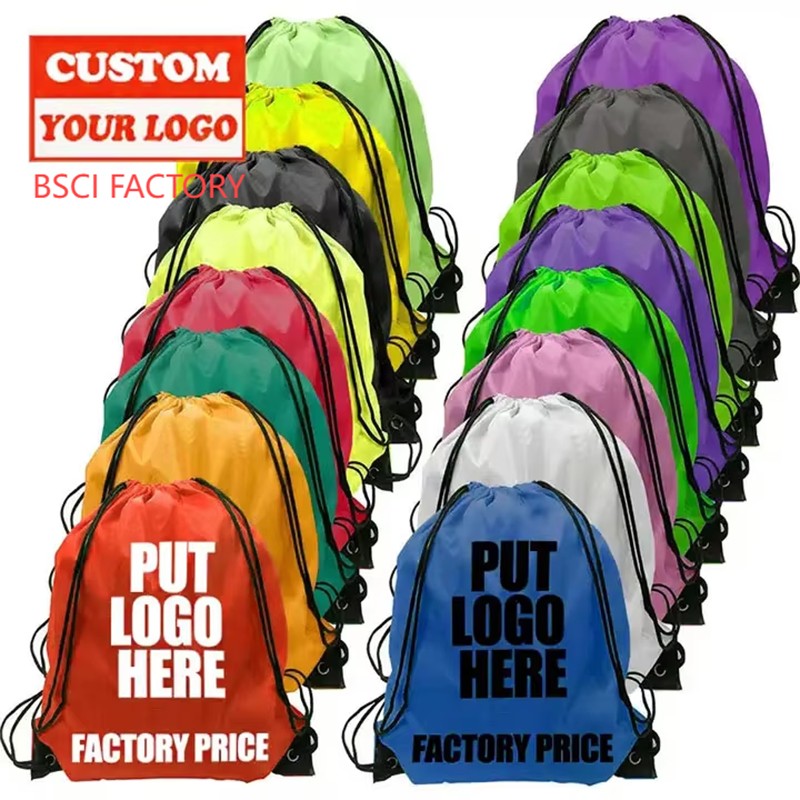



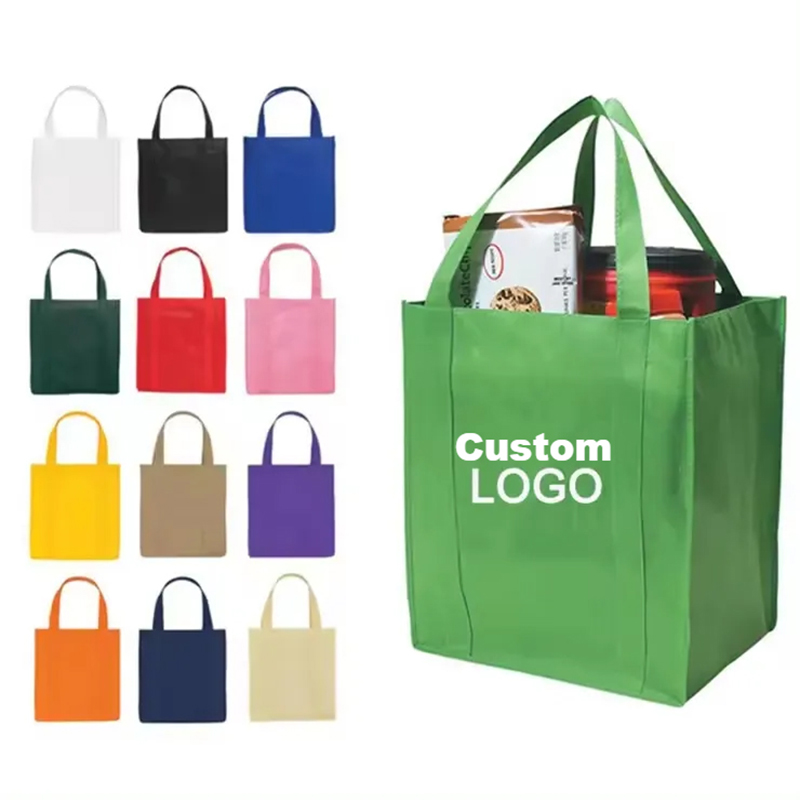
A non-woven sewing tote can look flawless in a catalogue and still fail on the first grocery run. Put a litre of milk and two glass jars in it and the base sags, the corners round out, and your printed panel folds into a shapeless lump. A hard bottom board solves that with a few grams of board and one extra sewing step. Below you will see what a bottom board actually does, why grocery and gift programs need one, how board materials differ, and how to write the spec into your next inquiry.
A hard bottom board is a rigid panel cut to the base footprint and built into the bag, either sewn inside a fabric sleeve or inserted loose under a base panel. On a sewn tote the base is the only plane with no structural support: stitching holds the edges together but adds nothing to stiffness. The board supplies that stiffness.
It does three jobs at once. It keeps the base flat and square instead of collapsing into a U shape. It spreads load from a single contact point, such as a bottle neck or a jar, across the whole base area. And it holds the silhouette, so your printed front panel stays vertical and readable when the bag is full.
| What changes | Without a bottom board | With a hard bottom board |
|---|---|---|
| Base shape under load | Folds into a U across the middle | Stays flat and square |
| Load path | Concentrated at the base seam | Spread across the panel edge |
| Standing position | Tips over when set down | Stands on a counter or shelf |
| Brand panel | Creases and curves away | Stays flat and legible |
| Empty bag | Packs dead flat | Folds flat along the side seams |
Notre eco non woven sewing tote bag with hard bottomboard is built this way: the board sits in a sewn sleeve under the base seam, so it cannot shift once the bag is loaded.
Grocery weight is deceptive. It arrives in small footprints: a one litre carton, a jar of sauce, four tins. Each one pushes down on a few square centimetres rather than spreading across the base. In an 80 to 120 gsm spun-bond shell, that point load pulls the base seam into a funnel and the fabric between the stitches starts to stretch.
You see the failure in three stages. First the bag will not stand while the cashier packs it, so packing drops to one hand. Then the base corners round out and you lose usable volume. Then the stitching at those corners starts to carry shear instead of tension, and that is the point where bags come back to you.
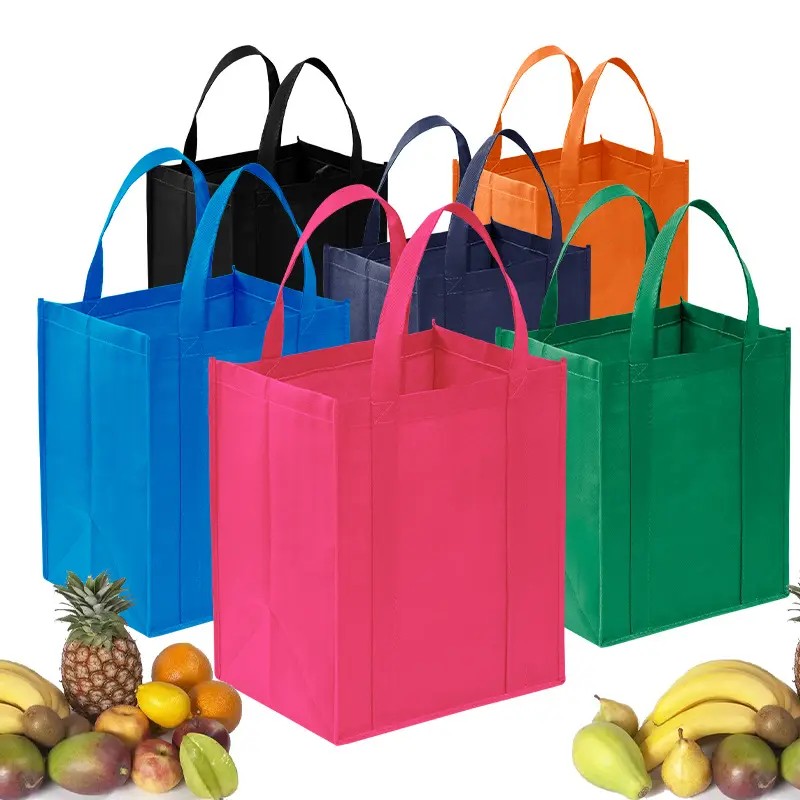
Base dimensions decide how much of this you can design out before a board is even discussed. If your current reference is a flat 34 x 42 cm tote, custom tote bag sizes walks through the trade-offs between height, base area and carry comfort.
Gifting is a different load case with the same physics. A gift bag usually carries rigid items such as a boxed mug, a cosmetics set or folded apparel, and the bag itself becomes part of the presentation. When the base sags the whole package tilts, the printed panel curves, and a premium giveaway starts to read as cheap.
A flat base also fixes the moment of handover. On a table at an event, at a hotel turndown or in a customer photo, a bag that stands on its own keeps your logo at eye level instead of collapsing into the frame. In the back room the effect is practical: rigid bases stack, soft bases slump, and staff reach for the bag that does not fall over.
This is why gifting programs often pair a board with a lighter shell rather than a heavier one. Stiffness comes from the board, so you can keep the fabric soft, foldable and cheap to ship without the bag looking flimsy on the table.
Four materials cover most programs. Each one buys stiffness in a different way, and the right answer depends on moisture, weight and what your market will accept at end of life.
| Board material | Typical thickness | Stiffness | Moisture | Fin de vie | Best for |
|---|---|---|---|---|---|
| Grey board (recycled paper) | 1.5 to 2.5 mm | Haut | Poor, warps when damp | Recycles with paper | Dry grocery, gift sets, retail |
| PP board | 1.5 to 2 mm | Medium to high | Good | Recycles in PP stream | Chilled goods, washable bags |
| PE foam board | 3 to 5 mm | Moyen | Good | Usually landfill | Premium gifts, soft feel |
| E-flute corrugated | 1.5 to 2 mm | Moyen | Poor unless coated | Recycles with paper | Large bases, light loads |
Match the board to the shell, not the other way round. On our sewing line the standard shell is non-woven fabric at 80 to 120 gsm, and the lighter the fabric, the more work the board has to do. A 120 gsm shell over a 2 mm board feels almost rigid; the same board in an 80 gsm shell still leaves a soft shoulder. If you are still settling fabric weight, the non woven bag GSM and size guide sets out what each grade does under load.
Thicker is not automatically better. A board that is too thick for the base will not sit flat inside the seam, and the bag rocks on its corners instead of standing on a plane. The whole sewing tote bag range is built to a stated base dimension for this reason: board thickness is chosen against the base, not against the bag height.
Tool: Bottom Board Spec Selector
Three steps. Match your load, read the board spec, then confirm the six inputs we need before quoting.
Step 1: choose the load profile closest to your program
2 mm grey board in a sewn sleeve, base 30 x 20 cm, shell 100 gsm. The flat base is what lets a cashier pack two-handed, and the sleeve stops the board sliding as bottles are dropped in.
1.5 to 2 mm grey board, or 3 mm PE foam board if the bag must feel soft, base 25 x 18 cm, shell 90 to 100 gsm. Stiffness here is about presentation and stacking, not load.
2 mm grey board as a loose insert, base 34 x 24 cm, shell 100 gsm. Loose inserts pack separately and ship cheaper than sewn boards at large base sizes.
1.5 to 2 mm PP board, base 30 x 20 cm, shell 100 to 120 gsm with lamination. PP keeps its shape when condensation or a wet wipe reaches the base.
Step 2: read the board against base area and load
| Base area (finished) | Light load, under 4 kg | Medium, 4 to 8 kg | Heavy, over 8 kg |
|---|---|---|---|
| Small, under 600 cm2 | 1.5 mm grey board | 2 mm grey board | 2 mm PP board |
| Medium, 600 to 1,000 cm2 | 2 mm grey board | 2 mm grey board | 2.5 mm grey board |
| Large, over 1,000 cm2 | 2 mm grey board | 2.5 mm grey board | 2.5 mm PP board |
Step 3: confirm these six before you request a quote
These figures are a starting point for sampling, not a guaranteed rating. The final board is confirmed on a physical pre-production sample carrying your own load.
Send us a base dimension and we will spec the board for you
Tell us the finished base, the load you expect and the shell weight. You get a board recommendation, a 2D drawing and a sample in 3 to 5 days.
Where the board sits matters more than how thick it is. Three builds are common, and each trades off differently.
Two tolerances decide whether the bag will sit flat. Cut the board 5 to 8 mm smaller than the finished base on each side and round the corners, because a board cut to exact size buckles the seam and lifts the corners. Then keep the handle anchor above the board line, so handle load travels into the board edge and the side seam rather than pulling the base stitching apart.
Stitch density at the base corners is the other half of the equation. Our standard build uses a locked stitch with backstitching at each corner, and the base sleeve is bound rather than left raw. For a deeper look at seam and handle options across styles, heavy duty tote bag construction covers the stitching choices in detail.
The board itself is cheap. What you are buying is the board plus a die-cut plus one extra sewing operation, and that bundle is usually a single-digit percentage of unit cost at volume.
| Configuration | Relative unit cost | What drives the number |
|---|---|---|
| Standard sewn tote, no board | 1.00 | Fabric, print, sewing |
| With hard bottom board in a sewn sleeve | 1.05 to 1.10 | Board, die-cut, sleeve sewing |
| With hard board and laminated print | 1.20 to 1.30 | Lamination and print set-up |
Treat that index as indicative only. Your quote moves with fabric weight, colour count and quantity, and quantity moves it far more than the board does.
Practical numbers from the sewing line: minimum order is 3,000 pcs on a standard hard-bottom build, samples ship in 3 to 5 days, bulk lead time runs 10 to 25 days depending on quantity, and bulk packing is 100 to 200 pcs per carton. If your volume sits below 3,000, the honest comparison is a heat sealed eco bag, which removes sewing from the cost base but also removes the sewn-in board sleeve, so base support has to be designed differently.
Most sample rounds are lost to missing specifications rather than to manufacturing. Send these six items and you will usually skip a revision cycle.
What comes back: a 2D drawing with base and board dimensions marked, a board spec sheet, a physical sample and a quote broken down by material and operation. If you already have a bag in production and only want to add support, say so early, because that changes the pattern work and not the artwork.
Wenzhou Zhongjin Packaging Co., Ltd. has been making shopping bags since 2018 from a 5,800 m2 factory in Longgang, Wenzhou, with 150 staff, more than 100 sewing machines and 15 R&D engineers. We hold ISO 9001, BSCI and SGS reports and ship to more than 80 countries.
Board cutting, intaglio and heat-transfer printing, ultrasonic welding and sewing all sit under one roof, which is why a board change does not restart your order. Sampling runs 3 to 5 days, and every hard-bottom build is checked for base flatness before packing.
It depends on the build. A loose insert lifts out through the base flap; a sewn-in sleeve keeps the board fixed. If end users will wash and reuse the bag, ask for the removable version and state it on the care label. Never machine wash a bag with a grey board inside: the board delaminates and the base never sits flat again.
A 2 mm grey board for a 30 x 20 cm base adds roughly 40 to 60 g per bag. On 3,000 pieces that is under 200 kg of total billable weight, so it rarely moves your freight tier. It does change how tightly the bags nest, so reconfirm carton quantity rather than assuming the same pack count.
Yes. The board sits only in the base panel, so the bag folds along the side seams exactly like a standard sewn tote. The one difference is crease memory: repeated folding on the board line leaves a soft ridge over time, so retail shelf programs often prefer loose inserts packed separately in the same carton.
It can, if board and fabric go into different waste streams. Grey board peels away from PP non-woven easily and recycles with paper; a PP board keeps the whole bag in one polymer stream. Send us the exact claim wording and destination market before you print, and we will pair materials that support it.
Usually yes. If your current bag already has a flat base seam, adding a board sleeve is a pattern change rather than a new mould, so there is no tooling charge and one confirmation sample settles it. If the bag is die-cut with no base panel, the pattern has to be reworked before any board can be fitted.
Grey board absorbs moisture and warps, which then shows as a wavy base. For humid routes we wrap boards in a PE bag, or specify PP board instead. Tell us at quotation if your container crosses a monsoon season or your warehouse is unheated; it changes the board material, not the bag design.
Yes. The board is a flat printable panel that most buyers leave blank, which makes it a low-cost place for care instructions, a reorder QR code, or a short campaign line that appears once the bag is empty. Single-colour print adds almost nothing to the unit price.
Yes. Boards can be cut to size, packed in their own carton and inserted at your warehouse or co-packer. Programs that personalise or overprint bags locally use this to keep boards out of the way during handling, and it also lets you hold flat bags and boards in separate stock lines.
With limits. A drawstring bag has no flat base panel, so the board becomes a shaped insert or a stitched base patch. Cooler bags gain the most: the board sits under the foam and stops the base collapsing as ice packs settle, which keeps the whole bag square in the car.
Run three checks on the pre-production sample: a static load test at your target weight held for 24 hours, a deflection reading on the centre of the base, and a corner drop from 80 cm. We photograph and record each result so the data goes into your own QC file alongside the sealed sample.
A hard bottom board is one of the cheapest upgrades you can make to a non-woven sewing tote, and one of the most visible to the person carrying it. It stops groceries funnelling into the base seam, keeps gift packaging upright in a photo, and holds your printed panel flat enough to read. Choose the board against your base area and load, decide early whether it should be removable, and put the spec in writing before sampling. Do that, and the bag behaves the way your brand promised.